
From Data to Decisions: Making More of Data Centre Capacity
Power is becoming a defining constraint on data centre growth. For operators with an existing grid connection, using less power for cooling and other supporting systems may allow more of that connection to serve IT, provided the facility can accommodate the extra load. At the same time, higher-density computing and liquid cooling place greater demands on the systems that keep equipment running reliably.
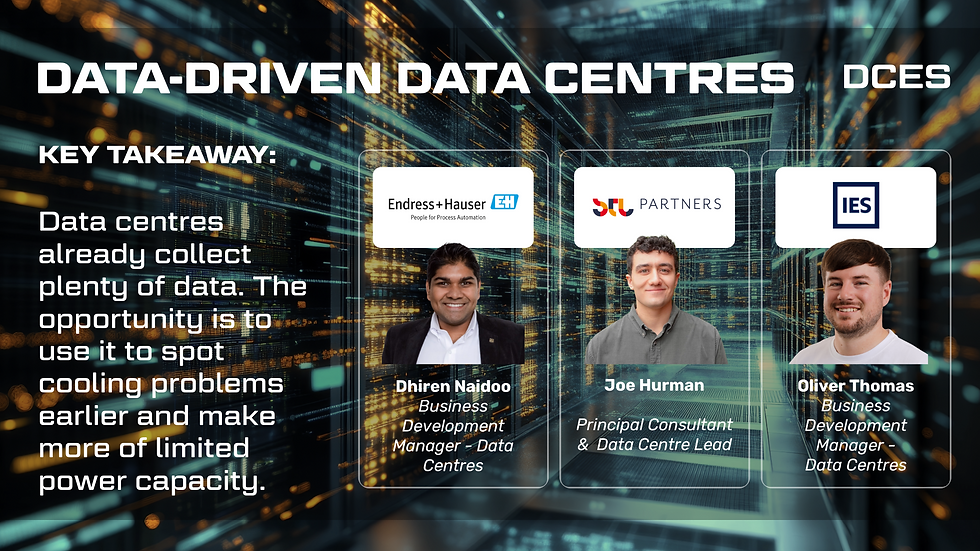
These were the themes of our Data-Driven Data Centres webinar, supported by Endress+Hauser. Joe Hurman of STL Partners, Dhiren Naidoo of Endress+Hauser and Oliver Thomas of IES examined how measurement, modelling and operational data can help operators make better decisions about cooling, energy and water.
The discussion made one point clear: collecting data is only the beginning. Its value lies in identifying what has changed, understanding why, and deciding what to do next.
Efficiency Is Also a Capacity Question
Joe Hurman began with three pressures facing data centre operators: access to power, operating cost and sustainability. In established markets, grid constraints make the capacity attached to an existing site particularly valuable. Reducing the electricity required by supporting systems can leave more of a fixed power connection available for customers’ IT.
As Hurman put it, operators are looking to “improve your facility efficiency to maximize your monetizable capacity.” Cooling performance therefore has a commercial consequence alongside its energy and environmental effects.
The shift towards higher-density racks raises the stakes. Liquid cooling can transfer heat from powerful chips more effectively, but it introduces fluid systems close to expensive equipment. A fault can affect a concentrated set of assets, making timely operational insight increasingly important.
Seeing More Than Temperature and Flow
Dhiren Naidoo described instrumentation as the “eyes and the ears of the data center.” Temperature and flow readings remain essential, but they may only reveal a problem once a cooling loop is already performing differently from expected.
The condition of the cooling fluid can provide another layer of information. Naidoo discussed monitoring properties such as conductivity, concentration and pH, as well as signs of contamination or material degradation. These measurements can help teams investigate a developing issue and decide when maintenance or fluid replacement is needed.
The goal is not simply to add more instruments. Hurman pointed to the risk of alarm fatigue for the people running a facility. Measurements need to help operators distinguish a meaningful warning from routine variation and act within the time available.
Connecting Design Expectations With Live Performance
Oliver Thomas argued that operators already have large amounts of information, often spread across separate building, power and cooling systems. Bringing it together is itself a challenge. The next step is to compare what a facility is doing with what its design model suggests should happen under the same load and conditions.
“A dashboard can show that performance has changed. Engineering analysis can help investigate why,” Thomas explained. An increase in cooling energy, for example, might reflect the weather, a change in IT load, a control issue or declining equipment performance. Each calls for a different response.
Modelling also helps teams test possible interventions before committing capital. That matters for both new facilities and existing sites considering higher rack densities, new cooling systems or changes to operating temperatures. Thomas emphasised that liquid cooling must be assessed as part of the whole facility, including the remaining air cooling and the system that ultimately rejects heat.
A More Precise Conversation About Water
Audience questions brought the discussion to water consumption. The speakers distinguished between fluid circulating within a cooling loop and water consumed by the wider facility. A closed loop may require relatively little top-up during normal operation, but the amount of water a data centre uses depends on its complete cooling and heat-rejection design.
The panel could not give a meaningful single figure for the water needed by an “average” UK data centre. Facility size, the share of IT equipment using liquid cooling, heat-rejection technology and maintenance practices all change the answer. That difficulty points to a wider need for clearer, comparable information, especially where local communities are concerned about water demand.
Turning Information Into Decisions
Across the discussion, the speakers approached the same challenge from different directions. STL Partners set out why power and capacity are now business priorities. Endress+Hauser showed how measurements can reveal what is happening within cooling systems. IES explained how modelling and analysis can put those readings in context.
Together, those perspectives suggest a practical sequence: measure the right things, bring the information together, investigate the cause of a change and then decide on an intervention. Better data can support efficiency and capacity, but those gains must be pursued while protecting the reliability on which data centre customers depend.


